
The Internet is a large database in which every website is like a sub-database. Usually, for any research, everyone mostly depends on search engines like Google, Yahoo & Bing. So, why not target this audience who are genuinely looking for your product or services? This can be done by influencing search engines for showing your website to the right audience with the right keyword. Search engine optimization is one type of digital marketing method to get an online presence.
The numbers agree with that. Google is around 97% of search in India, with about two-thirds of those searches happening on mobile, according to StatCounter’s data for 2026. So the real question isn’t if your customers are searching. It’s whether they find you or your competitor when they do.
Still the importance of organic search
BrightEdge’s channel research shows that about 53% of all trackable website traffic comes from organic search. Paid search was about 15% and social media was about 5%. Social platforms are great for awareness, but search is where people go when they’re ready to act.
Position is also very important. Backlinko analyzed 4 million Google results and found that the first result received an average of 27.6% of all clicks and was 10x more likely to be clicked than the 10th result. Less than 1% of clicks go to page two on Google.
What is SEO and how it works?
Search Engine Optimization- SEO is a long term process. We do SEO to secure top rank for our website for the targeted search term. SEO works with search engines so we have to understand how search engines work.
Search engines work in 3 steps:
Step 1: Crawling the website pages
Step 2: Indexing of a page in a search engine database for the targeted keyword
Step 3: Ranking the most relevant page for the targeted keyword
SEO works in two methods:
On-page SEO: In this method, actual website page content is optimized with a particular set of targeted keywords.
Off-page SEO: In off-page SEO all link building activities are carried out for website traffic improvement & brand awareness.
Technical SEO: In addition to these two, technical SEO makes sure search engines can crawl and understand your site. That includes page speed, mobile-friendliness, security (HTTPS), sitemaps and fixing broken links.
Both the methods are very effective for achieving top ranking with the targeted keywords & redirecting relevant audience on the website. To see how these fit together in practice, read our guide to the different types of SEO services.
How do SEO services help in business growth?
Here’s how professional SEO services can help you in the long run…
- Drive relevant organic search traffic or targeted audience (SEO doesn’t chase everyone, only people searching for what you offer. A visitor who searched “CA firm in Indore” is worth far more than one who stumbled on a random post.)
- Helps your brand achieve higher visibility and more exposure on Search engine like Google, Bing, Yahoo & more (showing up repeatedly builds familiarity and trust before anyone contacts you)
- Helps attract people that will convert into customers/clients (search traffic comes with built-in intent, which is why it so often turns into enquiries, calls and sales)
- The best part is it provides long term results (an ad stops working the moment you stop paying, while a well-ranked page keeps bringing in visitors for months or years)
- Helps move ahead of the competition (if you rank above them for the searches that matter, you get the clicks they would have got)
- SEO helps you to attract local customers (searches like “near me” and “in [city]” lead to calls, visits and direction requests. Local SEO services make sure your Google Business Profile, reviews and local pages are set up to win those.)
What this looks like in practice
Numbers by themselves can seem abstract, so here is a real-world example. When we started working with DY Patil University, they had a strong offline reputation but very little visibility on Google for the courses that students were looking for. We were getting about 950 clicks a day and 15,000 impressions a day.
We didn’t go for broad keywords, but treated each program as a search challenge in its own right, with its own keyword research, its own optimized page, and its own content answering the questions students ask – fees, eligibility, careers and the admissions process. We supplemented that with technical fixes and regular off-page work.
Over a span of 6 months Daily Clicks grew from 950 to 4,678 (392% growth) and Daily Impressions grew from 15,000 to 96,000 (539% growth). 15+ course-specific keywords ranked in the top 10 on Google. The work led to 15+ direct admissions for courses like MCA & BCA. Some of the university’s course pages are now being cited in Google’s AI Overviews, too.
The lesson is simple: good SEO isn’t about ranking for the sake of ranking. It’s about reaching the right person when they’re in decision mode.
SEO in the age of AI answers
SEO in 2026 cannot be discussed without mentioning that search is changing. It would be dishonest not to. Google’s new AI Overviews now offer direct answers to many questions on the results page. Pew Research found that when an AI Overview showed up, people clicked a regular result about 8% of the time—compared with about 15% of the time if it didn’t.
That doesn’t make SEO any less useful. It transforms what good SEO is. Data from Seer Interactive shows that pages referenced on an AI Overview obtain more clicks than uncited pages. The brands that win are those that produce content that is clear, well put together and reliable enough to be quoted.
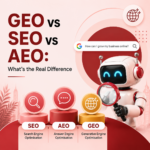
Enter two newer layers. Answer Engine Optimization (AEO) is the process of structuring your content so that it is selected as the direct answer. Generative Engine Optimization (GEO) helps you get your brand cited by tools like ChatGPT, Gemini, and Perplexity. Both rely on strong SEO underneath. We explain how the three are connected in GEO vs SEO vs AEO: what is the real difference.
How long does SEO need?
It takes time, honestly. Most businesses start to see movement in rankings and traffic within 3 to 6 months, depending on competition, the state of the website, and how consistently the work is done. SEO is more like setting up shop at a good place, than putting up a hoarding. It grows slowly, but keeps on paying dividends.
Top SEO Mistakes To Avoid
- Selecting keywords that no one searches for, or keywords that are too broad to convert.
- Ignoring mobile speed when most of the searches in India are on phones.
- Publishing thin or copied content to get more pages.
- Cheap bulk backlinks are a buy that can do more harm than good.
- Expecting results in two weeks and giving up too soon.
Conclusion
You may have an amazing product or service offering, but it is of no use if people do not have ideas about or are able to discover you online. While you can always start working on your website SEO with basic steps, it may be an excellent idea to get professional SEO consultant help, particularly if your business is expanding rapidly. As search engine optimization SEO is technical as well as requires good experience with result-oriented methods.
If you want to see what a structured approach can do, read how we helped DY Patil University grow organic clicks by 392% in six months.