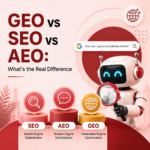
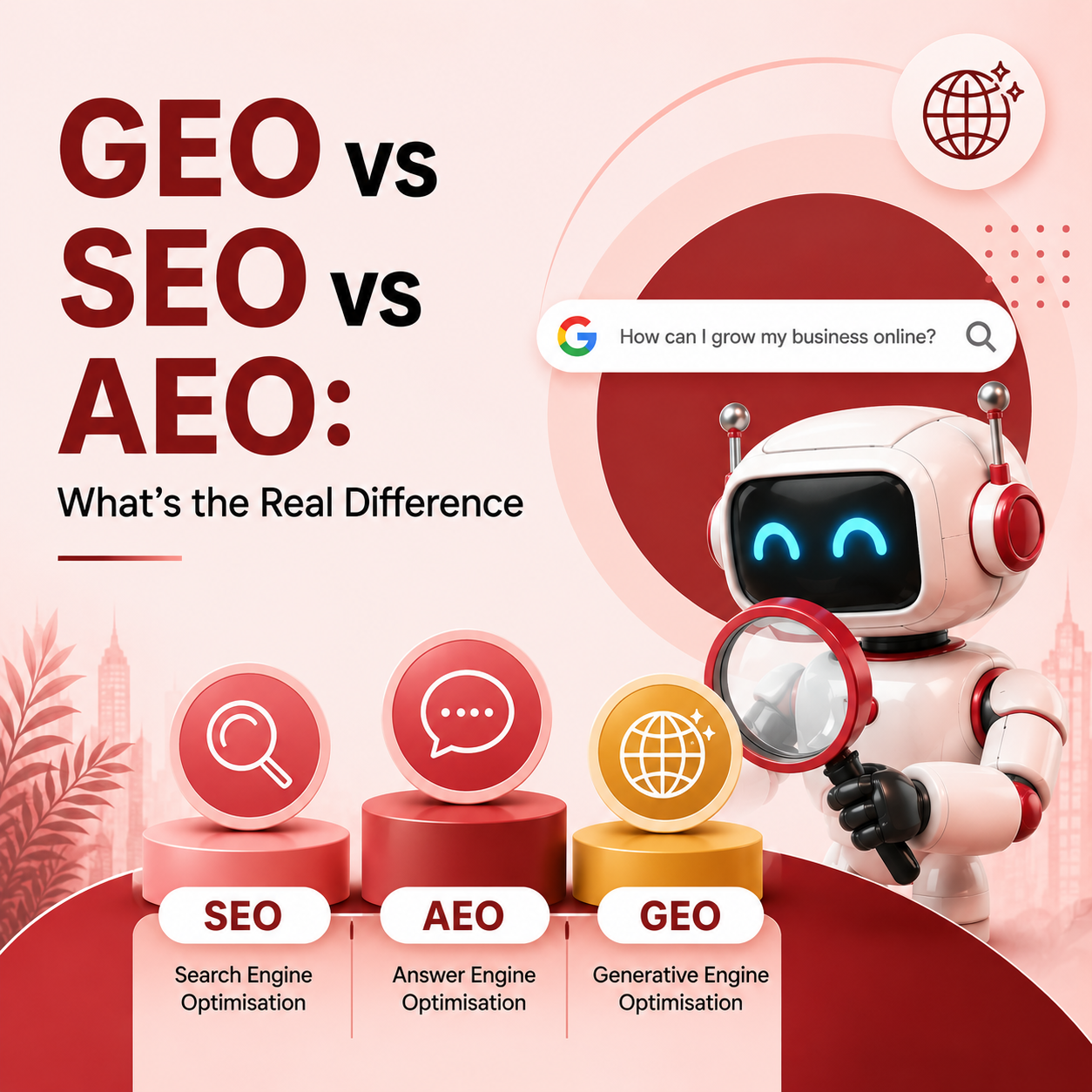
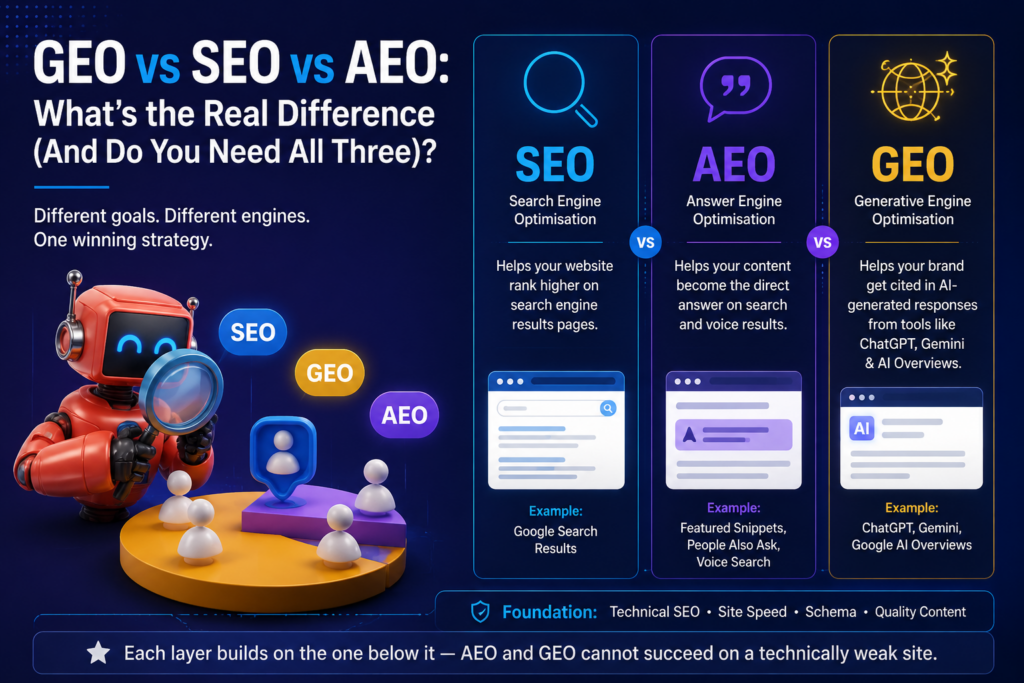
Quick Summary: SEO helps your website rank on Google’s search results page. AEO (Answer Engine Optimization) helps your content get pulled into direct answers. GEO (Generative Engine Optimization) helps your brand get cited inside AI-generated responses from tools like ChatGPT, Gemini, and Google AI Overviews. Most businesses today need all three working together, because customers are searching across all these formats simultaneously and not choosing one over the other.
If you’ve been hearing SEO, AEO, and GEO thrown around interchangeably lately, you’re not alone. Search behavior has changed faster in the last two years than it did in the previous decade, and the terminology has struggled to keep up. Understanding what actually separates these three approaches and where they overlap is now essential for any business trying to stay visible online.
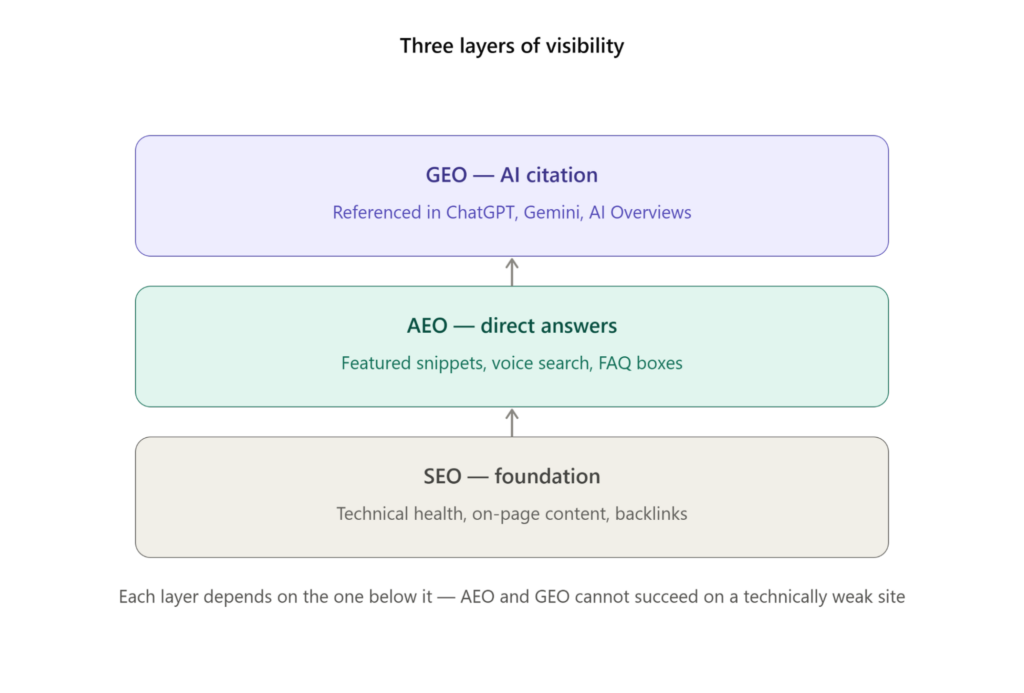
Show Image Each layer builds on the one below it — AEO and GEO cannot succeed on a technically weak site.
What Is SEO (Search Engine Optimization)?
SEO is the practice of optimizing your website so it ranks higher on traditional search engine results pages (SERPs), primarily Google. It’s built around three core pillars:
- Technical SEO — site speed, mobile-friendliness, crawlability, structured data
- On-page SEO — keyword optimization, meta tags, content quality, internal linking
- Off-page SEO — backlinks, domain authority, brand mentions
The goal of SEO is simple, when someone types a query into Google, your website appears as high up in the list of ten blue links as possible. It’s been the backbone of digital visibility for over two decades, and it still matters because a huge share of traffic still flows through traditional search.
But SEO alone no longer captures the full picture of how people find information today.
What Is AEO (Answer Engine Optimization)?
AEO focuses on getting your content selected as the direct answer to a question, not just a ranked link, but the actual answer displayed on the page. This includes:
- Featured snippets (“position zero” on Google)
- Voice search results (Alexa, Siri, Google Assistant)
- The “People Also Ask” boxes
- FAQ-rich results
AEO content is typically structured very differently from standard SEO content. It favors:
- Clear, direct question-and-answer formatting
- Concise definitions early in the content (usually within the first 40–60 words)
- Structured data markup like FAQPage and HowTo schema
- Content organized around specific user questions rather than broad keyword themes
Where SEO asks “how do I rank for this keyword,” AEO asks “how do I become the answer to this question.”
Because AEO demands ongoing structural and content changes, many businesses choose to bring in a dedicated AEO agency rather than handling it in-house. Professional AEO services typically cover schema implementation, FAQ architecture, and continuous monitoring of snippet and voice-answer performance.
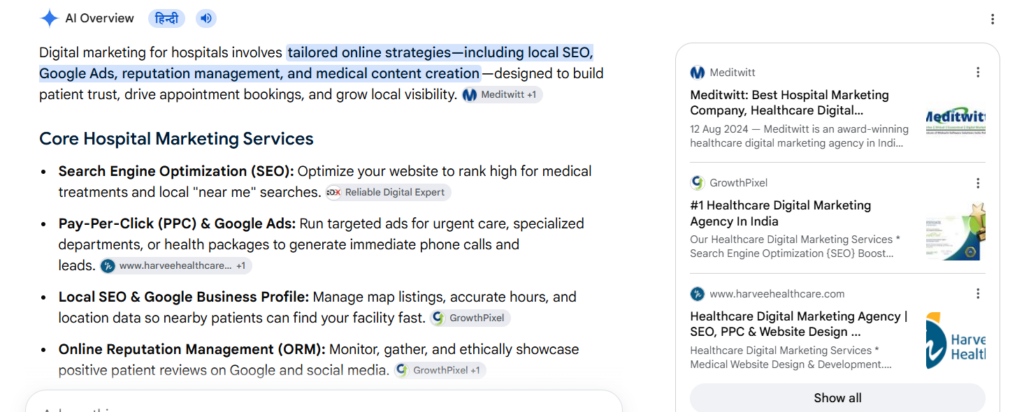
Example: A Google AI Overview pulling structured, bulleted content directly into the answer box — this is AEO/GEO visibility in action, not just a ranked link.
What Is GEO (Generative Engine Optimization)?
GEO is the newest of the three, and it’s growing the fastest. It focuses on optimizing content so it gets cited, summarized, or referenced by generative AI tools — ChatGPT, Gemini, Perplexity, Claude, and Google’s AI Overviews.
Unlike traditional search, these platforms don’t return a list of links. They synthesize an answer from multiple sources and present it directly to the user often without the user ever clicking through to a website. GEO is about making sure your brand is one of the sources that AI model pulls from and cites when it builds that answer.
Effective GEO strategy typically involves:
- Building topical authority through comprehensive, well-organized content.
- Getting cited across multiple credible third-party sources (directories, publications, forums)
- Structuring content so AI models can easily extract and attribute facts
- Maintaining consistent, accurate information about your brand across the web
- Using clear headings, definitions, and structured formatting that AI crawlers can parse easily
GEO is less about ranking and more about earning trust and citation from AI systems that are increasingly acting as the first (and sometimes only) touchpoint in a customer’s research journey.
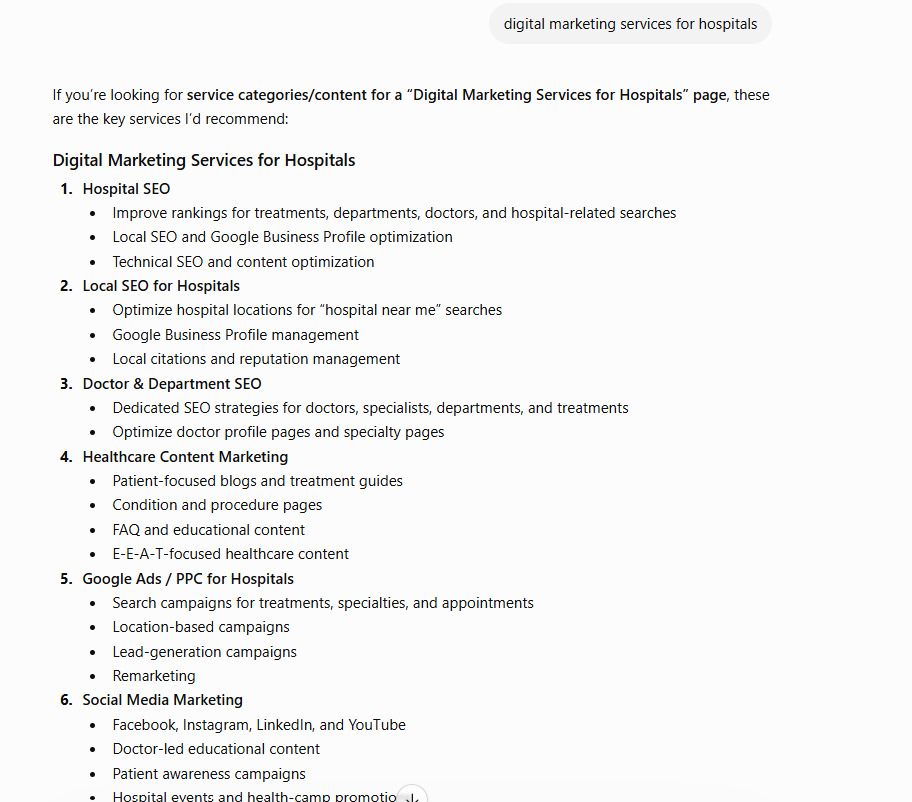
Example: An AI assistant organizing a full service breakdown (SEO, PPC, content, social media) in response to a single query — showing how GEO-optimized, well-structured content gets synthesized directly into an answer.
Because GEO is still evolving, many brands work with a specialized GEO agency to build citation-worthy authority faster than they could alone. Generative engine optimization services typically combine content restructuring, off-site authority building, and citation tracking — the kind of coordinated work a generative engine optimization agency is built to deliver.
SEO vs AEO vs GEO: Key Differences at a Glance:
| Factor | SEO | AEO | GEO |
| Primary Goal | Rank on search results pages | Become the direct answer | Get cited in AI-generated responses |
| Platform Focus | Google, Bing search results | Featured snippets, voice assistants | ChatGPT, Gemini, Perplexity, AI Overviews |
| Content Style | Keyword-optimized, comprehensive | Concise, question-and-answer | Structured, fact-dense, citation-friendly |
| Success Metric | Rankings, organic traffic | Snippet wins, voice answer share | AI citation frequency, brand mentions in AI answers |
| User Behavior | Clicks through to website | May not click — gets answer on page | Often doesn’t click — trusts the AI summary |
Why the Confusion Is Growing
Search volume for terms like “AEO,” “GEO,” and “AI SEO” has climbed sharply over the past year, and it’s easy to see why. The lines between these three disciplines aren’t as clean as the table above suggests. In practice:
- Strong technical SEO (fast site, clean structure, schema markup) is a prerequisite for both AEO and GEO, you can’t optimize for AI citation if your site isn’t technically sound to begin with.
- AEO techniques like FAQ structuring and direct-answer formatting directly improve your chances of being cited by generative AI tools too.
- GEO often depends on off-site signals: directory listings, third-party mentions, review platforms that traditional SEO has always cared about, just applied to a new set of platforms.
This is why most agencies now treat SEO, AEO, and GEO as layers of the same strategy rather than three separate disciplines competing for budget.
Do You Need All Three?
For most businesses today, the honest answer is yes, but the balance depends on your industry and customer behavior.
- If your customers still primarily search and click through (e-commerce, service businesses with local intent), SEO remains your foundation, with AEO layered on top for FAQ and snippet visibility.
- If your industry involves research-heavy or comparison-driven decisions (healthcare, education, B2B services, finance), GEO is becoming critical — because more customers are asking AI tools to summarize and compare options before ever visiting a website.
- If voice search or quick factual queries are common in your space (recipes, local business info, how-to content), AEO deserves dedicated focus.
In nearly every case, the businesses seeing the strongest results are the ones treating this as one integrated strategy — technically sound SEO, answer-structured content for AEO, and citation-worthy authority building for GEO — rather than picking just one.
The Bottom Line
SEO gets you found. AEO gets you the direct answer. GEO gets you cited by the AI tools an increasing number of your customers are turning to first. As search behavior continues to fragment across traditional engines, voice assistants, and generative AI platforms, businesses that only invest in one of these three are leaving significant visibility on the table.
The shift isn’t about abandoning SEO for GEO — it’s about building content and technical foundations strong enough to perform across all three simultaneously.
Frequently Asked Questions
Q1. Is GEO replacing SEO? No. GEO builds on top of strong SEO fundamentals — technical health, structured data, and content quality all remain essential. GEO adds an additional layer focused specifically on AI citation, rather than replacing traditional search optimization.
Q2. How is AEO different from GEO if both are about “getting answers”? AEO focuses on structured answer formats within search engines themselves — featured snippets, voice results, People Also Ask boxes. GEO focuses specifically on being cited or referenced by generative AI models like ChatGPT and Gemini, which synthesize answers from multiple sources rather than displaying a single snippet.
Q3. Can a small business realistically invest in all three at once? Yes, and often more easily than expected — because the disciplines overlap. A well-structured website with clear FAQs, solid technical SEO, and consistent brand information across the web supports SEO, AEO, and GEO simultaneously rather than requiring three separate strategies.
Q4. How do I know if my content is being cited by AI tools? Tools are emerging to track AI citation visibility across platforms like ChatGPT, Gemini, and Google AI Overviews, similar to how rank trackers monitor traditional SEO performance. Manually testing relevant queries across these platforms is also a simple starting point.
Q5. Which should a business prioritize first — SEO, AEO, or GEO? Start with SEO fundamentals, since they form the technical and content foundation the other two depend on. Once your site is technically sound and ranking reasonably well, layering in AEO-style FAQ content and GEO-focused citation building delivers compounding returns.